

By Siyu Feng, Joseph Stemmler, Diarmid Roberts and Mark Workman – CO2RE
This blog is Part 2 in a three-part series about how better decision-making tools can help the UK CDR sector to scale up. Read Part 1 here and Part 3 here.
New research highlights that when policies arrive – not just what they are – will determine whether the UK can build a world-class carbon removal industry in time to meet its net zero targets.
Despite the UK having one of the most active and entrepreneurial carbon dioxide removal (CDR) communities in the world, it currently still has no carbon removal industry to speak of. The government’s own climate projections suggest that we need one capable of pulling tens of millions of tonnes of CO₂ out of the atmosphere every year within a generation. To get there, it plans to use policy tools like long-term contracts (called Carbon Contracts for Difference, or CCfDs) and the integration of CDR credits into the UK Emissions Trading System. But analysis by researchers at CO2RE has shown that these policies will not be sufficient to kickstart the CDR sector in the UK. We are asking more pointed questions: what others are needed and in what order should those policies land? How will they shape the decisions of the companies that would actually build and run these technologies?
Why costs fall and why it matters
Like other technologies before them, carbon removal technologies are expected to get cheaper the more they are deployed. For this analysis we have explored how two different types of learning might impact cost reduction. First, learning-by-doing: firms get better and faster as they build more plants, reducing costs through experience. Second, learning-by-searching: companies invest in research and development (R&D), pushing scientific and engineering frontiers so that future systems cost less to build and run.
Most past policy analysis assumes that these cost reductions happen automatically, as a kind of background fact, applying cost curves externally to the model through a stylised set of assumptions (see figure 1, below). A new CO2RE study takes a different approach: it builds a model in which a firm’s own choices – how much to build, how much to invest in research – directly shape how fast costs fall. That changes everything, because different policy sequences create different incentives, and therefore different rates of learning in different potential futures.

Figure 1: Assumed learning in conventional innovation analysis. Taken from Young, et al. (2023). https://doi.org/10.1016/j.oneear.2023.06.004
What our analytical framework model found
For the CO2RE learning curve study, we tested hundreds of combinations of policy settings, initial technology costs and learning assumptions for a technology called direct air capture (DAC) (see figure 2), asking what would be required for the sector to meet a hypothetical target of 5 MtCO2 of DAC per year by 2035. Some headline findings stand out. Under pessimistic conditions – high starting costs, slow learning – even generous contracts may not be enough to trigger meaningful deployment by 2035. Under more optimistic assumptions, a well-designed policy sequence combining CCfDs with a modest R&D tax credit can significantly boost both long-run removals and private investment in research. The gap between best and worst outcomes in the model is large – a strong argument for humility about any single forecast.
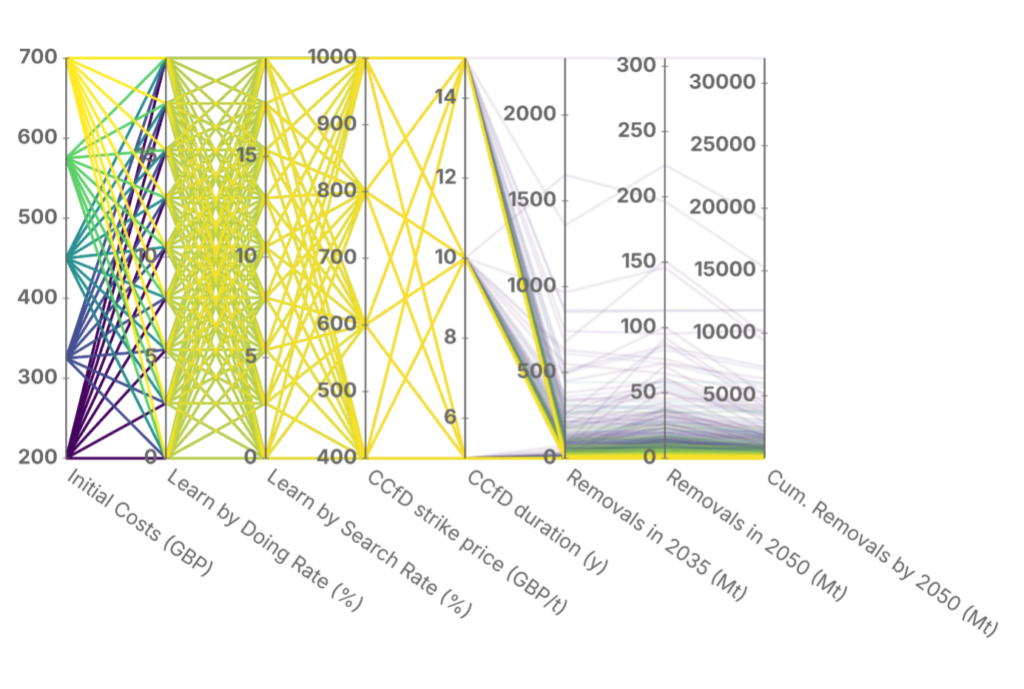
Figure 2: All possible scenarios under assumptions according to survey responses. Note: Input variables are initial costs, learning by doing, learning by search, CCfD strike price and CCfD duration. Output variables are removals (per year) in 2035, removals (per year) in 2050, and cumulative removals by 2050. Figure created by the authors.
What happens next
The research team is now working directly with policymakers, start-up developers, and investors to stress-test these findings. Crucially, the project’s goal is not to predict the future. It is to map out which policy choices leave the UK most resilient across a wide range of possible futures, and to give decision-makers honest tools for navigating the deep uncertainty associated with learning rates for such a nascent technology. A full-day workshop in May 2026 brought together these groups to challenge the orthodox analysis and sharpen our research insights before producing analysis for consumption by the UK CDR community. We’ll look at this in more detail in Part 3.
Photo by Maksym Ostrozhynskyy on Unsplash.